

BlogDestinationsSouthern Patagonia Icefield Expedition
Southern Patagonia Icefield Expedition
Table of contents

Lisa Germany
Aug 21, 2026
Lisa is a travel writer and photographer who originally comes from a small town in Australia. She quit her full-time job in 2016 (she was previously a professional Astronomer and then an eLearning/Learning Spaces expert for Universities) and has been travelling the world ever since.
The Southern Patagonia Icefield Expedition is not a regular multi-day hike. Fewer than 200 people per year take on this challenging route, which climbs up onto the third largest icefield in the world and tracks along the back side of the famous Fitz Roy mountain range near El Chaltén, Argentina.
As the name suggests, this is more of an expedition than a trek, requiring specialized equipment and glacier knowledge. However, it is not so extreme that it is out of the reach of experienced hikers. If you have done several long distance hikes carrying a full backpack and are looking for a new challenge, undertaking this guided expedition will fit the bill. Lisa’s essay on long-distance hiking names this expedition as the hardest hike she has done.

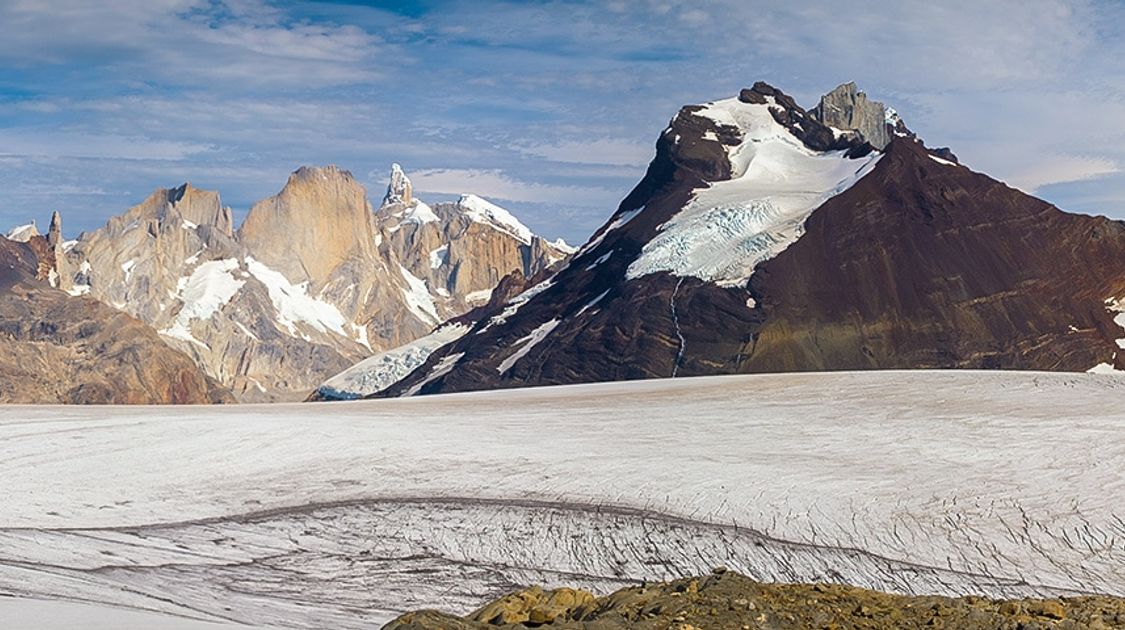
Looking south on Southern Patagonia Icefield Expedition

FitzRoy mountain rage view from Icefield on Southern Patagonia Icefield Expedition
The Basics
Closest Major City: El Calafate, Argentina. You can fly to El Calafate directly from Buenos Aires.
Start: El Chaltén. El Chaltén is a small town at the base of the Fitz Roy mountain range and the centre of hiking in Argentine Patagonia. Although you can rent almost any outdoor gear you need here, it only has a couple of small stores for groceries. You are better off stocking up in El Calafate. There are several buses per day between El Calafate and El Chaltén.
Accommodations: Camping in expedition-style tents. There is also the possibility of a night in the Refugio Garcia Soto hut.
Costs: Several providers offer this trek from El Chaltén. Costs vary depending on provider but most start somewhere around US$2,300 including permits, transportation, guides, food, expedition tents, and other specialized equipment.
Length: 7 Days, plus days in reserve for bad weather.
When to Go: mid-November through mid-March. Early in the season you will be predominantly snowshoeing. Later in the season, you will be wearing crampons and glacier hiking for several days.
Recommended Company: Serac Expeditions. I did this expedition with them and have only the highest praise.
This is a very remote trek that takes you into extreme conditions. There is no trail and unless you have extensive backcountry experience and know how to read a glacier, you must do this as a guided expedition. This route description assumes you are doing this guided. Browse our guided tours in South America for the wider region.

Lisa Germany with all her gear on Southern Patagonia Icefield Expedition

Collecting drinking water with Gorra Blanca on Southern Patagonia Icefield Expedition
Health
You must be fit and accustomed to carrying a heavy backpack for several days in order to undertake this trek. It is not an easy trek, even with good weather, and the starting weight of your pack is likely to be at least 21 kg. The good news is that water is plentiful and safe to drink so you only need to carry 1 L at a time. Our backpacking gear checklist covers the basics, though this trek needs far more.

Roped together for safety on Southern Patagonia Icefield Expedition

Hikers with the rope on Southern Patagonia Icefield Expedition
You must be prepared for extreme weather. Make sure you bring appropriate and sufficient layers (including a quality waterproof/windproof complete outer layer) and a sleeping bag/sleeping pad that will keep you warm enough when camped on the icefield. Depending on the weather, there is a risk of frostbite/hypothermia if you are not properly equipped. For this reason, the company I hiked with went through every single item I planned to take with me the day before the expedition, to ensure I was properly equipped. Our Arc’teryx Beta AR hard shell review covers the outer layer this calls for.
For several days of this hike, you will be walking on a massive glacier. Crevasses abound and are one of the key dangers to health on this trip. Make sure you follow instructions from your guides carefully and you will be fine.

Zipline across a raging river on Southern Patagonia Icefield Expedition

Hikers on an exposed path on Southern Patagonia Icefield Expedition
You must have footwear that includes strong ankle support. Hiking on hard ice with crampons for several days (especially in the later part of the season) takes a toll, and if you suffer from weak ankles this may not be an appropriate trek for you. Even with good ankles, we were really feeling it after a couple of days.
Undertaking the expedition is also not a smart choice if you suffer from vertigo or are worried about heights in general. There are ziplines over fast flowing rivers on the first and the last days, and the climb to the Refugio Garcia Soto on Day 2 had us scrambling up vertical cliffs onto narrow ledges with enormous drop-offs. I also found that the crevasses started to “pull me in” after a day of constantly jumping over them.

Fitz Roy mountain rage view from Refution Garia Soto on Southern Patagonia Icefield Expedition

Back side of the Fitz Roy mountain rage on Southern Patagonia Icefield Expedition
The Route
The expedition starts at the Río Eléctrico, about 15 km from El Chaltén. A well marked trail leads to the Piedra del Fraile hut and campsite through the Lenga trees, but don’t be fooled by this nice, easy start! Beyond the hut, special permission is required and there is no trail. You actually need to know where you are going!
This “no-man’s land” between Argentina and Chile is stunningly beautiful, with glorious views of the world’s third largest icefield as well as the Fitz Roy and other mountain ranges. It is also incredibly challenging, with ziplines across raging rivers, vertical ascents often involving narrow ledges, and the constant need to navigate safely through massive crevasse fields. The challenge can be made even more difficult due to the unpredictable and often ferocious nature of the weather, and it is not uncommon for expeditions to have to turn around after several days of forced confinement.

Steep climb up the glacier on Southern Patagonia Icefield Expedition

Relaxing at Refugio Paso del Viento on Southern Patagonia Icefield Expedition
That being said, if the weather does cooperate and you complete the circuit, you will have encountered many of the different types of environments present in southern Patagonia, and achieved an off-the-beaten-path experience in this otherwise popular trekking destination.
Day 0: Gear check in El Chaltén. For my trek, the guides from Serac Expeditions literally went through everything I planned to take with me to ensure it was suitable. If it wasn’t, they would have sent me off to hire or shop for appropriate gear.
Day 1: Transfer from El Chaltén to Río Eléctrico – hike to a campsite beyond the Pollone River crossing. Exact campsite TBD depending on progress of the group and weather. 6-8 hours
Day 2: Campsite - Refugio Garcia Soto. 5-7 hours
Day 3: Refugio Garcia Soto - Circo de los Altares. 5-6 hours
Day 4: Circo de los Altares - Laguna Ferrari. 6-7 hours
Day 5: Laguna Ferrari - Refugio Paso de Viento. 2-3 hours
Day 6: Refugio Paso del Viento - Bahía Témpanos. 7-8 hours
Day 7: Bahía Témpanos - Bahía Túnel – transfer to El Chaltén. 6-7 hours
Route options:
- If the weather forecast is good, your guides may use one of your reserved weather days and summit Gorra Blanca (2,907 m) from the Refugio Garcia Soto. It is a very long, steep climb but the reward is 360-degree views of the surrounding landscape
- From the Refugio Paso del Viento, it is worthwhile dumping your heavy packs at the intersection with the Huemul Trail and heading up to the Paso del Viento itself before continuing to Bahía Témpanos.
- An alternate exit from the Refugio Paso del Viento is to take the Paso del Viento and follow the Huemul circuit directly back to El Chaltén

Ascent Gorra Blance on Southern Patagonia Icefield Expedition

Approaching the summit of Gorra Blanca on Southern Patagonia Icefield Expedition
Accommodation
This is a remote trek with the possibility of staying in a hut on only one of the nights. The company you hike with should equip you with an expedition-style tent that can withstand extreme weather conditions, as the weather on the icefield can turn very bad, very quickly. You will be expected to carry half of this tent (your tent-partner will carry the other half) and your guides will teach you both how to pitch it on the first night.

Pitching camp on Southern Patagonia Icefield Expedition

Refugio Garcia Soto on Southern Patagonia Icefield Expedition
Food
You will be expected to carry a share of the group food, but the guides will cook and there may even be some unexpected treats for you along the way!
With Serac Expeditions, we only carried enough food for 6 days and were met at the Refugio Paso del Viento by porters with a re-supply. This, of course, is up to the individual company. Our best backpacking stoves guide covers cooking on self-supported trips.
More From Lisa
Lisa Germany
Aug 21, 2026
Lisa is a travel writer and photographer who originally comes from a small town in Australia. She quit her full-time job in 2016 (she was previously a professional Astronomer and then an eLearning/Learning Spaces expert for Universities) and has been travelling the world ever since.
Recent stories
Destinations
Where to Go Instead: 10 Less Crowded Alternatives to Europe’s Famous Trails
Europe's best-known hiking trails deserve their reputations, but popularity changes the experience.
Nadine Gravis
Sep 16, 2026
Destinations
Best Family Adventure Tours for Kids 12 and Under
As most parents know, family adventure travel is hard to plan while your children are young.
Richard Campbell
Sep 16, 2026

Destinations
How Much Does the Tour Du Mont Blanc Cost?
How much does the Tour du Mont Blanc cost in 2026?
Kelsey Krahn
Sep 15, 2026