
Complete Camino Frances Self-Guided Pilgrimage
Cancel anytime during the quoting process.


Overview
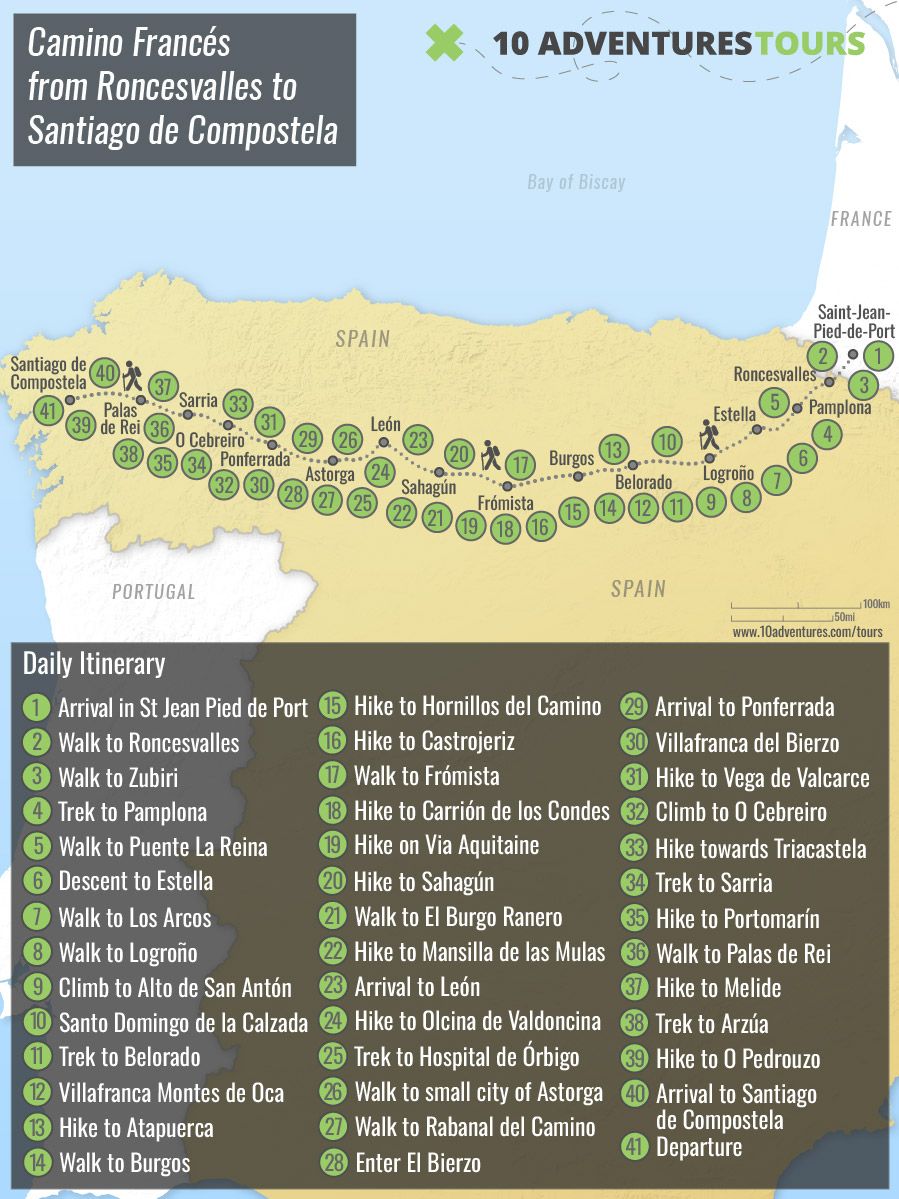
Walk the complete Camino Francés from Saint-Jean-Pied-de-Port in France to Santiago de Compostela in Spain on a remarkable 41-day self-guided pilgrimage. Following the most iconic route of the Camino de Santiago and covering 743 km on foot, this journey crosses northern Spain from east to west, tracing a path walked by pilgrims for centuries in search of reflection, connection, and adventure.
From the Pyrenees and the vineyards of La Rioja to the wide-open Meseta and the green hills of Galicia, the landscapes shift beautifully as the route unfolds. Along the way, you’ll pass through some of the Camino’s most celebrated towns and cities, including Pamplona, Logroño, Burgos, León, Palas de Rei, and finally Santiago de Compostela, where the journey ends at the magnificent cathedral.
Each night, enjoy the comfort of charming, locally run small hotels and bed and breakfasts, staying in private rooms with ensuite washrooms and breakfast included each morning. Luggage transfers and detailed route materials are included, making it easy to focus on the walk itself, and optional rest days can be added for those who wish to break up the journey and spend more time exploring along the way.
This once-in-a-lifetime journey is waiting to be walked. Book your Complete Camino Francés adventure and discover for yourself why this legendary pilgrimage continues to inspire travellers from around the world!
Complete Camino Frances Self-Guided Pilgrimage Overview
Walk the complete Camino Francés from Saint-Jean-Pied-de-Port in France to Santiago de Compostela in Spain on a remarkable 41-day self-guided pilgrimage. Following the most iconic route of the Camino de Santiago and covering 743 km on foot, this journey crosses northern Spain from east to west, tracing a path walked by pilgrims for centuries in search of reflection, connection, and adventure.
From the Pyrenees and the vineyards of La Rioja to the wide-open Meseta and the green hills of Galicia, the landscapes shift beautifully as the route unfolds. Along the way, you’ll pass through some of the Camino’s most celebrated towns and cities, including Pamplona, Logroño, Burgos, León, Palas de Rei, and finally Santiago de Compostela, where the journey ends at the magnificent cathedral.
Each night, enjoy the comfort of charming, locally run small hotels and bed and breakfasts, staying in private rooms with ensuite washrooms and breakfast included each morning. Luggage transfers and detailed route materials are included, making it easy to focus on the walk itself, and optional rest days can be added for those who wish to break up the journey and spend more time exploring along the way.
This once-in-a-lifetime journey is waiting to be walked. Book your Complete Camino Francés adventure and discover for yourself why this legendary pilgrimage continues to inspire travellers from around the world!
Complete the epic 743 km pilgrimage along the Camino Frances, the premier pilgrimage route to Santiago de Compostela.
Visit gorgeous historical architecture as you travel the ancient path, from medieval bridges to gothic churches and fairy-tale palaces.
Savor delicious local cuisine in traditional villages and hamlets as you unearth the beating heart of authentic Spain.
Discover an everchanging landscape as you pass through wild mountains, rambling vineyards and vibrant cities on the trail.


Trip map for Complete Camino Frances Self-Guided Pilgrimage
Barbara C.
Amalfi Coast Bicycle Tour
We went through 10Adventures not familiar with them at all, and it was the best decision we ever made!
Allyson K.
Everest Base Camp
Just an amazing experience. Absolutely lifechanging!
Amy D.
XC Skiing in the Dolomites
It was a fantastic trip and Nadine was extremely responsive to all of our questions.
Itinerary for Complete Camino Frances Self-Guided Pilgrimage
Arrive in Saint Jean Pied de Port
Today you will check into the French village of Saint-Jean-Pied-de-Port, close to the foothills of the Pyrenees. You can explore the cobbled streets of this gorgeous medieval town, rich in Basque culture and overflowing with beautiful buildings. After a filling dinner at your hotel, you can wander down to the river before you settle in for a good night’s sleep ahead of your adventure.
Your Camino Frances begins
Today you will cross from France into Northern Spain, reaching the Spanish town of Roncesvalles. After enjoying breakfast at your hotel, you will begin this adventure with one of the most challenging walking days. The panoramic views from the Pyrenees mountain range will make all the effort worth it. If you would prefer to take a gentler approach to Roncesvalles, you can arrange to take an alternate route through the valley. You will have your well-earned dinner and rest at a lovely hotel in Roncesvalles.
Walk to Zubiri
Having left France behind you, the rest of the Camino Francés is in Spain. The trail becomes more gentle today, as you follow the course of the Erro river and continue to admire the snowy peaks of the Pyrenees. On arriving in Zubiri, you can visit the town’s legendary medieval bridge, believed to have great healing powers in days gone by. A hearty dinner at your hotel will be sure to replenish your energy.
Walk to Pamplona
Walking alongside the Arga river, the sound of flowing water and birdsong will accompany you for the beginning of your walk. Observe the landscape start to transform as you approach the famous city of Pamplona. Feel the lively energy of Pamplona lift your spirits as you indulge in a comforting meal at your hotel. If you would like the opportunity to explore Pamplona’s vibrant streets and delicious tapas, you can add an additional night to your trip when you book.
Walk to Puente de la Reina
Navigating the paved roads of Pamplona, you will see its colorful buildings and treelined boulevards. Heading back into the countryside you will enjoy a breathtaking view of the city you just left behind and pass through several smaller towns where you can enjoy a coffee with fellow pilgrims. You can visit the Pilgrim Statue in the Alto del Perdón before you arrive at your hotel in the pretty town of Puente de la Reina, named after its stunning 11th century Romanesque bridge that crosses the River Arga.
Walk to Estella
Having left the bustling crowds of Pamplona behind, the landscape quickly becomes more peaceful as you wander through farmlands and vineyards. You will discover the ruins of an ancient Monastery and cross ancient Roman Bridges before arriving in Estella for dinner and a good night’s rest. Estella is rich in history, with plenty of basilicas, churches and even an old palace to admire.
Walk to Los Arcos
Savoring your breakfast in your hotel, you can be proud of yourself for completing the first week of this ancient pilgrimage. Heading into the heart of wine culture, you will pass through olive groves and vineyards on this pleasant, rural trail. Once you arrive in Los Arcos, why not sample some local Irache wine with a plate of cured meats and cheeses at a local eatery. Your dinner will be provided in the hotel, where you’re sure to sleep soundly after 7 days on the trail.
Walk to Logroño
Today’s hike passes through lovely countryside, with hilly terrain. Breathe in the smell of pine as you meander through the forests, before arriving at the outskirts of the capital of La Rioja region, Logroño. This iconic city is rich in religious architecture and overflowing with local bars which serve the region’s world-famous wine. You are welcome to pre-book an extra night to enjoy all that Logrono has to offer, but otherwise you should get a restful night ahead of tomorrow’s walk.
Walk to Nájera
As you move away from the city, the sights and smells of nature will greet you once again. Today’s trail will see you walk through vineyards and enjoy the shade of fruit trees. Stop to enjoy the view from San Anton peak and appreciate the traditional pottery of the historic town of Navarette. You can arrange to stay in Navarette on this day if you would prefer a shorter walk. Otherwise, push on to the lovely town of Nájera where you can refuel your body with food and rest.
Walk to Santo Domingo de la Calzada
Travelling on foot, you will see the landscape transform before your eyes. Today the vineyards will slowly be replaced with fields of grain, as you enjoy an easier walk on flat terrain. Enjoy a meditative journey through the countryside before you reach the more urban area on the outskirts of Santo Domingo de la Calzada. Exploring the streets of the city, there is plenty of culture and history to be discovered, including the legend of the chicken that sang after it was roasted!
Walk to Belorado
After 10 days of hiking, your body will be adjusting well to life on the trail. Walking across the Castilian plateau of Meseta, the mountains on the horizon will seem frustratingly slow to approach, and you’ll find yourself entering a steady rhythm to overcome this psychological challenge. Luckily, today is a relatively short walk which will take you to the peaceful town of Belorado for some rest and recuperation.
Walk to Villafranca Montes de Oca
Today’s 12 km walk from Belorado to Villafranca Montes de Oca is a shorter and gentler stage of the Camino Francés, following quiet country paths and rural tracks through small Castilian villages and open farmland. As you leave Belorado behind, the landscape gradually becomes more wooded and rolling, offering a peaceful transition toward the Montes de Oca foothills. Arrive in the historic village of Villafranca Montes de Oca, once an important medieval pilgrim stop and gateway to the hills ahead.
Walk to Atapuerca
Today’s walk takes you through the Sierra de Atapuerca, where wide-open views, peaceful woodland trails, and gently rolling farmland make for a pleasant and relatively comfortable stage. Along the way, you’ll pass through San Juan de Ortega, home to a beautiful Gothic monastery and long associated with the Camino’s medieval pilgrimage history. Your day ends in Atapuerca, located near one of the world’s most important archaeological sites, famous for its remarkable prehistoric discoveries.
Walk to Burgos
Your walk from Atapuerca to Burgos begins with peaceful countryside trails and a climb through the open landscapes of the Sierra de Atapuerca, with broad views across the Castilian plains. As the route descends, the scenery gradually shifts from farmland and small villages to the urban approach into Burgos. Your efforts are rewarded on arrival in this magnificent historic city, home to one of Spain’s finest Gothic cathedrals and a lively old town filled with Camino atmosphere.
Walk to Hornillos del Camino
Although the route has now entered the Castilian plateau, where the stages are mostly flat and seemingly comfortable, the weather can make this section more demanding. Summer temperatures are often very high, with limited shade along the way, while winter can bring very cold conditions. These challenges are balanced by the beautiful medieval towns and historic villages encountered throughout the route.
Walk to Castrojeriz
This stage follows a similar profile to the previous day, crossing the open fields of Castilla where summer heat and limited shade can make the walk more demanding. The final kilometres follow the road before reaching Castrojeriz, a historic Camino town home to the Collegiate Church of Santa María del Manzano and an interesting museum of sacred art.
Walk to Frómista
Leaving Castrojeriz, the route climbs Alto de Mostelares, gaining around 145 metres in less than two kilometres. This is the main challenge of the stage, but the effort is rewarded with wonderful views across the Castilian plateau. The day ends in Frómista, one of the great landmarks of the Jacobean tradition and an important centre of Romanesque heritage in Palencia.
Walk to Carrión de los Condes
This very flat stage crosses the open plateau and presents no major difficulties, making for a steady and comfortable day on the Camino. The route passes through Villalcázar de Sirga, where highlights include the Church of Santa María la Blanca and the Mesonero monument, which celebrates the traditions of the Way of St. James and Jacobean gastronomy. In Carrión de los Condes, the Monastery of San Zoilo is a must-see, offering one of the town’s most important historic and architectural landmarks.
Walk to Calzadilla de la Cueza
This stage is one of the quietest sections of the Camino Francés, with fewer services and stopping points along the way. The route follows the historic Via Aquitania, also known as Roman Road XXXIV or Asturica Burdigalam, the ancient road that once connected Astorga with Bordeaux.
Walk to Sahagún
Leaving Calzadilla de la Cueza, the route begins with a short climb of around two kilometres before continuing through small valleys and open countryside. After crossing the Valderaduey River and entering the province of León, the stage ends in Sahagún, one of the most distinctive towns on the Camino de Santiago. Known for its Mudéjar heritage, Sahagún is home to the remarkable churches of San Tirso and San Lorenzo.
Walk to El Burgo Ranero
After leaving Sahagún, the Camino crosses the River Cea and continues across the open León countryside. The path leads through Bercianos del Real Camino before arriving in El Burgo Ranero, with much of the day spent walking gentle, comfortable trails between wide grain fields and big Castilian skies.
Walk to Mansilla de las Mulas
A very flat and straightforward stage, this section of the Camino follows an almost direct line toward Mansilla de las Mulas. Comfortable dirt tracks make for easy walking, while a shaded woodland stretch offers welcome relief during the warmer summer months. Villages are limited along the way, but the stage ends pleasantly in Mansilla de las Mulas, where the banks of the Esla River provide a lovely place to rest after the walk.
Walk to León
This stage leads into León, one of the great capitals of the Way of St. James and a major highlight of the Camino Francés. The route follows sections closer to busier roads than previous stages, though the climb over Portillo Hill offers a rewarding view that signals the approach to the city. Once in León, the magnificent cathedral, Gaudí’s Casa Botines, and the Hospital de San Marcos are must-see landmarks, while the old town and lively Barrio Húmedo are perfect for enjoying well-earned tapas after the walk.
Walk to Oncina de la Valdoncina
Leaving the grand city of León behind, today’s walk begins with an urban departure before gradually easing into the quieter countryside west of the city. The route to Oncina de la Valdoncina is a shorter Camino stage, offering a gentle transition from León’s historic streets and magnificent cathedral to the open landscapes and small villages that define the next stretch of the journey.
Walk to Hospital de Órbigo
From Oncina de la Valdoncina, today’s walk continues west through the quieter countryside of León, following a mostly gentle route of open farmland, small villages, and classic Camino pathways. As you near Hospital de Órbigo, the stage ends with one of the route’s memorable sights: the long medieval bridge of Puente de Órbigo, a historic crossing that leads you into this welcoming pilgrim town for the night.
Walk to Astorga
This stage marks a gradual return to more varied terrain, with the landscape becoming increasingly undulating as the Camino approaches Galicia. After leaving Hospital de Órbigo, the route crosses gently hilly countryside before arriving in Astorga, a fascinating small city rich in Roman heritage. Astorga is also an important Camino crossroads, where the Camino Francés meets the Vía de la Plata, and serves as the historic capital of the Maragatería region.
Walk to Rabanal del Camino
This stage leads deeper into the Montes de León, where the landscape becomes more rugged and the Camino begins to feel increasingly mountainous. Rolling hills grow steadily larger along the route, creating a more varied and scenic walking day as the journey continues west toward Galicia.
Walk to El Acebo de San Miguel
This stage leaves the Maragatería region behind and enters El Bierzo, bringing a return to the varied terrain of the mountains. The first major ascent leads to one of the most symbolic places on the Camino de Santiago: the Cruz de Ferro on Mount Irago. At around 1,500 metres, this is the highest point of the Camino Francés and a deeply meaningful stop for many pilgrims.
Walk to Ponferrada
This stage continues through the heart of El Bierzo, a region celebrated for its rich gastronomy, traditional dishes such as botillo, and excellent wines with their own denomination of origin. The Camino leads onward to Ponferrada, the regional capital and an important centre of Jacobean tradition. On arrival, the impressive Castle of the Templars is a standout highlight and one of the city’s most memorable historic landmarks.
Walk to Villafranca del Bierzo
Across the heart of El Bierzo, this stage follows comfortable walking trails through a landscape shaped by open fields, rural scenery, and vineyards. The day ends in Villafranca del Bierzo, one of the Camino’s most atmospheric towns, where the Church of Santiago is especially significant for its Puerta del Perdón, a historic “Door of Forgiveness” traditionally associated with Jacobean years and the pilgrimage to Santiago.
Walk to Vega de Valcárcel
This is a mostly flat and gentle stage, offering a comfortable day on the Camino and a good opportunity to conserve energy before the more demanding walking ahead. The route follows sections of the old N-VI road and continues alongside the Valcarce River for the final stretch, creating an easy and relaxed approach to the day’s destination.
Walk to O Cebreiro
This stage takes on the legendary climb to O Cebreiro, the gateway to Galicia on the Camino Francés and one of the most demanding ascents of the Spanish section. The route gains nearly 700 metres on the climb via La Faba, a challenging but spectacular section often considered one of the most beautiful and emotional days on the Camino. The effort is richly rewarded on arrival in the enchanting mountain village of O Cebreiro, a place of deep Jacobean tradition, remarkable cultural heritage, and unforgettable views across the Ancares.
Walk to Triacastela
This stage is defined by its steady ups and downs as the Camino continues through the high landscapes of Galicia. The route first climbs toward Alto de San Roque, where the famous pilgrim statue offers encouragement before the more demanding ascent to O Alto do Poio at 1,337 metres. Although not especially long in distance, the climbing makes this one of the more challenging stages, followed by a rewarding descent toward Triacastela.
Walk to Sarria
The walk to Sarria is a shorter and gentler stage, beginning in the direction of San Xil and continuing through some of Galicia’s most beautiful rural scenery. Quiet paths lead through the peaceful San Xil Valley, where green hills, small hamlets, and lush countryside create a wonderfully scenic approach to Sarria, one of the most important starting points for pilgrims walking the final stretch to Santiago.
Walk to Portomarín
Sarria is a popular starting point for many pilgrims, as it lies just before the final 100 km required to receive the Compostela in Santiago. This relatively gentle stage has few significant climbs and leads deeper into Galicia, where chestnut and oak woods, rivers, meadows, and quiet rural paths create a beautifully atmospheric walk. Passing through charming villages such as Barbadelo and Ferreiros, the route continues toward Portomarín, where the Miño River signals the arrival into this historic town, rebuilt above the waters of the Belesar Reservoir.
Walk to Palas de Rei
The walk begins with a climb toward the Serra de Ligonde, reaching around 725 metres and offering a rewarding sense of progress through the Galician countryside. Green landscapes, rural paths, and some paved sections shape the day, while traditional stone “cruceiros” begin appearing more frequently along the route. Notable villages such as Castromaior, Ventas de Narón, and Ligonde add to the quiet charm of this Camino stage.
Walk to Melide
Continuing toward Campo dos Romeiros, an important historic meeting point for pilgrims, the route leads onward in the direction of Leboreiro. Lush forests and peaceful rural paths make for a pleasant Galician day, with a medieval bridge crossing adding a memorable final touch before reaching Melide.
Walk to Arzúa
Leaving the province of Lugo behind, the Camino enters A Coruña and continues through a series of charming Galician villages. With fewer kilometres to cover, there is time to enjoy peaceful stops in places such as Boente and Castañeda before arriving in Arzúa, a lively Camino town especially known for its traditional local cheese.
Walk to O Pedrouzo
A short and quiet day on the Camino, this stage offers time to reflect on the incredible journey so far before the final approach to Santiago. Gentle paths and peaceful Galician scenery create a calm, contemplative atmosphere, making this a meaningful pause before reaching the end of the pilgrimage the following day.
Final Walk to Santiago de Compostela
Excitement, anticipation, and a mix of emotions mark the final stage of the Camino. An early start is recommended for those hoping to arrive in time for the midday Pilgrim Mass, with the route first passing through Lavacolla before climbing Monte do Gozo, where the towers of Santiago’s cathedral may finally come into view. From there, the path leads into the city and onward to Plaza del Obradoiro, where the journey ends with the unforgettable satisfaction of reaching Santiago de Compostela.
End of Your Camino
Your pilgrimage on the Camino de Santiago has finally come to a close. It’s possible to pre-book extra days in Santiago to really relax and unwind after 743 km on the trail. Alternatively, you can check out today and head back home, with plenty of stories to share with your loved ones.
Dates and prices for Complete Camino Frances Self-Guided Pilgrimage
Single Room
Double Room
Triple Room
| Single Room | Double Room | Triple Room | |
|---|---|---|---|
| Sep 1, 2026 to Nov 15, 2026 | $8,150USD | $4,475USD | $4,275USD |
| Mar 15, 2027 to Jun 30, 2027 | $8,925USD | $5,295USD | $4,650USD |
| Jul 1, 2027 to Aug 31, 2027 | $9,995USD | $5,925USD | $5,225USD |
| Sep 1, 2027 to Oct 31, 2027 | $8,925USD | $5,295USD | $4,650USD |
| Optional Extras | |||
| Dinners for 39 Nights (per person)$1,775USD | |||
What’s included for Complete Camino Frances Self-Guided Pilgrimage
Meals
40 breakfasts are included.
Accommodations along the Camino Francés
The accommodation for 40 nights along the tour is included.
Transportation during the Tour
This tour includes luggage transfers only.
Also Included
- 24-hour emergency line
- Galician cheese tasting in Santiago
- Maps for all stages
- Guided Tour in Santiago de Compostela (old town)
- Pilgrim pass
- Pilgrim scallop
Not Included
- Guide services
- Any personal transport
- Flights
- Meals, drinks, or snacks not previously mentioned
- Tips
- Gratuities for tour guides or other staff if desired
Optional Extras
- Additional nights before or after the tour
- Single occupancy upgrades
- Optional activities or excursions
- Half board supplement
- Picnic Supplement
- Private transfer to Roncesvalles
- Private transfer to the airport
- One day tour:
-
- Santiago - Fisterra
- Santiago - Rías Baixas & Wine Tasting
- Santiago - Rías Baixas, Wine Tasting & Boat Trip
- Extra piece of luggage
Accommodation for Complete Camino Frances Self-Guided Pilgrimage
During this trip you will mostly stay in quaint hotels, bed & breakfasts, and pensions along the Camino route. These accommodations cater to pilgrims, providing an authentic Camino experience and modern amenities for comfort. They are most often locally owned and operated.
Single Rooms and Solo Travelers
Rooms are double occupancy. You can pay a supplement to have a private room in a hotel where possible. Solo travellers may be required to pay a supplement.
Reviews
These reviews reflect all trips offered by this local tour partner on 10Adventures, not just the tour you’re viewing.
Frequently asked questions for Complete Camino Frances Self-Guided Pilgrimage
How hard is the Complete Camino Francés Walk?
We rate this tour as a 4 / 5. The difficulty of the Full Camino Francés Pilgrimage is moderate to challenging due to the varying terrains, consistent daily distances of up to 29 kilometers, and the endurance required for the 40-day journey.
Do I need a Visa to travel to France and Spain?
Check with your local country about visa requirements. You could also try this website, though you should verify with your government.
Are meals included on the Complete Camino Francés Walk?
40 breakfasts are included.
Do I need insurance?
Yes, it is mandatory to have Health and Medical insurance to join this trip. Get your Travel Insurance.
How do I get to Saint-Jean-Pied-de-Port to start this tour?
The closest airport to Saint-Jean-Pied-de-Port is 50 km away in Biarritz. Biarritz airport has connections to several European cities, as well as most of the major cities in France.
What if I get tired during the Camino de Santiago?
If you feel that the itinerary is too strenuous for you, you can always add an additional resting day when booking your tour. Make sure to do that in advance, as changing the booking days for the accommodations that are already booked is very hard to do.
Where does the Complete Camino Francés Walk tour end?
The Camino de Santiago ends in Santiago de Compostela.
Will I get lost without a guide?
The route is well maintained and clearly marked, and you will also be provided with detailed maps. However, you will also be given a support number that you can call at any time should you need any help or advice.
What will I do for lunch?
There are many places where you can buy some lunch along the Camino Frances. By organizing this for yourself, you can stop to rest when you personally feel ready to eat, as well as having the opportunity to taste the authentic Spanish cuisine offered along the route. Alternatively, you can buy a picnic lunch at a local supermarket to enjoy in a pretty spot along the trail.
Do I need special vaccines to travel to Spain and France?
Check with your family doctor.
Are there any travel restrictions for Spain and France?
Please check with your local government about travel restrictions before you book your tour. This map from the US Department of State provides an overview of the current status in countries around the globe. The UK‘s Foreign Office and Government of Canada also provide advice on foreign travel. Note that the travel advice may change depending on your nationality.
When is the best time to travel to Spain for this tour?
The best time to travel to Northern Spain for this walking adventure is spring and autumn, though the tour can be completed year-round. Summer is the most popular time, but it can be quite warm.
Why book Complete Camino Frances Self-Guided Pilgrimage with 10 Adventures?
Self-guided Specialists
Combine the freedom of travelling on your own with the confidence that all of the logistics are taken care of.
Packed with Inclusions
Accommodations, luggage transfers, gear rentals, and more - all taken care of so you can focus on making memories.
World Class Support
Have peace of mind for when travel plans change with our hassle-free booking process and unbeatable support.
Let's start talking about your next adventure!