

BlogTrip GuidesPlanning Your Trip to Banff National Park in 2026
Planning Your Trip to Banff National Park in 2026
Table of contents

Richard Campbell
Apr 26, 2026
Richard is the Founder of 10Adventures, and as a writer shares his experience from 30+ years exploring the world by foot, bike, ski, and boat.
Let us help you plan your trip to Banff: How to get there, getting around Banff, Banff weather and the best Hotels, restaurants and attractions in Banff.
Banff National Park is one of Canada’s most valuable treasures – spanning 6,641 sq km across a stunning natural landscape, complete with emerald lakes, abundant wildlife, staggering peaks and spectacular views. Banff began as a 27 sq km (6670 acres) hot springs reserve (and Canada’s first national park). Today, it’s a UNESCO World Heritage Site and consistently ranks among the world’s top outdoor destinations. In winter, it’s a skier’s paradise, and in summer the pristine waters beckon all that pass by. The park also boasts more than 1,600.0 km of maintained trails—perfect for adventurous hikers. Need we say more?
One of the best parts about Banff, is that it’s a section of a larger region, blessed with a number of other natural attractions, namely other hiking areas on our site: Canmore hiking trails, Lake Louise hiking trails and the Icefields Parkway hiking trails. Banff, however, is the tourist centre. While you can stay in any of these areas, you’ll find the most variety and activity in Banff. For those heading further north, our Jasper National Park hiking trails guide covers another outstanding hiking destination just two hours up the Icefields Parkway.
Banff is located just a 90 minute drive (140.0 km) from Calgary and roughly 850.0 km from Vancouver. The main roads in Banff are the Icefields Parkway (Route 93 North), the Trans-Canada Highway (Route 1) running into Banff from Calgary in the east, the Bow Valley Parkway (Route 1A), and the Lake Minnewanka Drive. With all roads, snowfall can limit accessibility and wildlife crossings are frequent. Keep an eye out. If you’re driving into the park, you’ll need to purchase a park pass; entry is free June 19 to September 7, 2026 under the Canada Strong Pass.
Here we’ll take you through the basic overview of hiking in Banff National Park—including how to get there, where to stay, where to eat, what to see and what to watch out for. Browse all Guided Canadian Rockies Hiking Tours.


What to Expect in Banff National Park in 2026
Planning your visit to Banff National Park in 2026? Here is what every visitor should know:
- Canada Strong Pass, FREE entry summer 2026: Entry is FREE June 19 to September 7, 2026 under the Canada Strong Pass. No park pass required during this period. Outside these dates: day passes are C$12.25 per adult; Discovery Pass is C$83.50 adult or C$167.50 family/group, valid at all Parks Canada locations for 12 months.
- Moraine Lake, mandatory shuttle (CRITICAL): Private vehicles are not permitted on Moraine Lake Road during peak season. Access is by Parks Canada shuttle only; advance booking is required and sells out weeks ahead. Book at reservation.pc.gc.ca before your trip.
- Best time to visit: Late June and September to early October offer the best combination of good weather, open trails and smaller crowds. July and August are peak; expect busy trails, full campgrounds and higher hotel rates. December to March is prime ski season.
- Getting there: Calgary International Airport (YYC) is approximately 90 minutes by car (140 km). Roam Transit shuttles connect Calgary and Canmore to Banff. A rental car is strongly recommended for exploring the park beyond the town.
- Wildlife: Bears, elk, wolves, deer and bighorn sheep are regularly seen. Always carry bear spray. Keep a safe distance from all wildlife and drive slowly at dawn and dusk when animals are most active on roadways.
What's New in Banff in 2026
What’s new in Banff for 2026? The biggest news for summer visitors is the Canada Strong Pass: entry to all national parks including Banff is completely free from June 19 to September 7, 2026. No park pass is required during this window.
Peyto Lake viewpoint – one of Banff’s most photographed spots on the Icefields Parkway – has undergone a major renovation and the upgraded Peyto Lake viewpoint is now fully open with improved accessible walkways and viewing platforms.
Moraine Lake access continues under the mandatory shuttle system, in place since 2022. Book your shuttle in advance through the Parks Canada website as these sell out weeks ahead of peak summer dates. Lake Louise lakeshore parking fills by 7–8am in July and August; arriving before sunrise or using the shuttle is strongly recommended.
Basic Info for Banff
Currency: Canadian Dollars
Time Zone: Mountain Standard Time (GMT – 7)
Language: English
Country phone code: +1 is the international country code for Canada
Emergency Phone Number: 911
Banff Visitor Centre: 1-403-762-1550 or Email: banff.vrc@pc.gc.ca
Park Entrance Day fees: C$12.25/adult, C$10.45/senior, C$5.90/youth
Family/group (up to 7 people in one vehicle): C$24.50
Discovery Pass: C$83.50 adult / C$167.50 family
Note: entry FREE June 19 – September 7, 2026 (Canada Strong Pass)
Which airport to fly into get to Banff
You can easily access Banff from Calgary International Airport, serving many major international and North American airlines. You can drive a private vehicle or take one of the regular shuttle connections from the airport to Banff and Lake Louise.
You can also hire a private transport service between Calgary and Banff.
When to go to Banff
Banff is essentially a year-round destination, but the more popular times to visit are from June to August and December to March. The warmest months draw the biggest crowds, but promise an unforgettable experience—the mountain lakes are at their most stunning, whereas the majority of the year they are still frozen. As well, during this time you’ll have the best access to hiking and biking routes.
We find the best time to visit is late-June as well as September and early-October. These times combine good weather, limited snow in the alpine and lower crowds.
From December to March, Banff’s cold weather (it rarely gets above freezing) doesn’t deter visitors. Rather, they are drawn to the region’s first-class skiing and winter activities for a wide variety of ages and levels. Winter is also a great time for hiking and snowshoeing – complete with enchanting waterfalls, towering glaciers and much more.
During the spring (April and May) the weather is highly volatile. You may get caught in a blizzard or be able to bask in the warm sun. This is the best time of year to spot wildlife, especially bears, and is one of the least expensive. And if you’re willing to experience the chill of winter without the guaranteed blanket of snow, late-October through November is a good time to visit Banff. Again, the weather is very unpredictable, but the crowds are the smallest and the hotels the cheapest.
Average monthly temperature and precipitation:

Average monthly temperature in Banff
How to get around in Banff
There are a few options to get around Banff National Park. The best option is to drive your own vehicle or rent a car at the airport or in the town of Banff. You will also need to make sure you purchase a park pass online or when entering the park.
You can also take public transit within the town of Banff—known as the “Roam”—which offers regular trips throughout the town itself and Bow Valley. There are also taxi services in Banff and Lake Louise area 24-hours a day and can be hailed on the street, called by phone, or found at one of several taxi stands throughout the town.
Where to stay in Banff
Banff boasts a wide variety of accommodation options - whether you’re looking for a complete indulgence and luxury, a dash of design and history, or simply a place to rest your head at night. For families, we suggest the Banff Hidden Ridge Resort. Tucked into a ridge that overlooks Banff town, these condos can fit up to eight people - complete with open fireplaces, outdoor hot tubs and swimming pools, spectacular mountain views and a full kitchen.
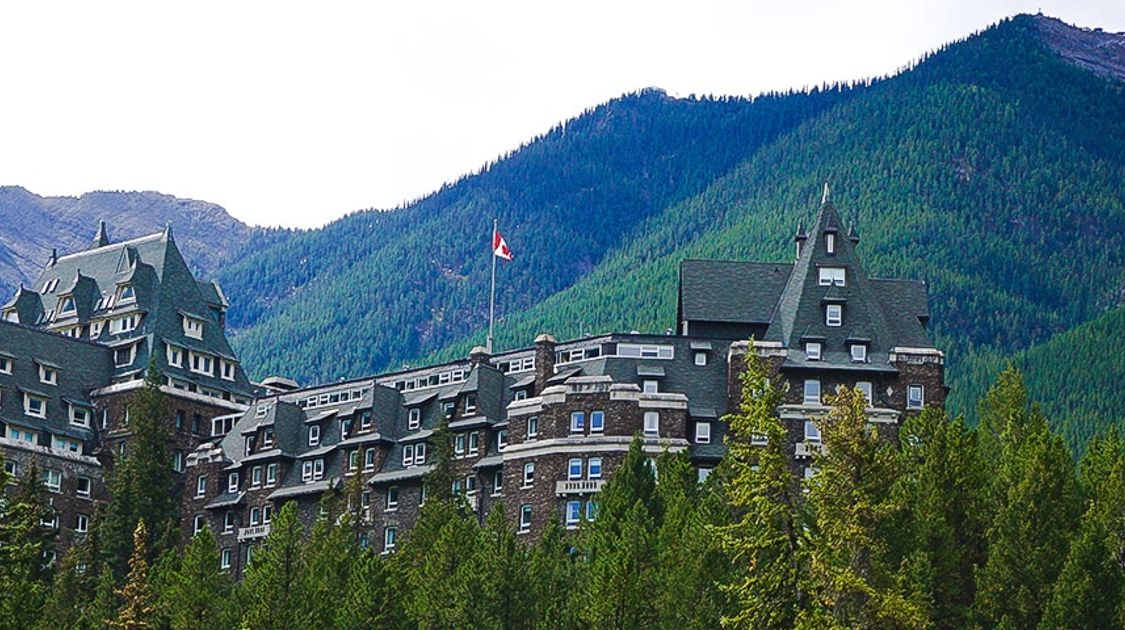
If you’re looking for luxury, the Fairmont Banff Springs Hotel is just the ticket. Nicknamed the “Castle in the Rockies” - as this is literally located inside of an old castle - this hotel is packed with everything you would want: a full spa and fitness centre, world-class dining, a golf course, and - of course - beautiful scenery in the heart of Banff National Park.
We also suggest the Moose Hotel and Suites. Just minutes from Banff centre, this accommodation also boasts two rooftop pools. As well, The Juniper is a rustic, cozy, and renovated locally-owned hotel in the heart of Banff National Park.
If you’re on a budget, we definitely suggest one of the hostels from HI Hostels such as the HI-Banff Alpine Centre. Dorm beds start around $30 and include the City Transport Pass, free WiFi, nightly activities and quick access to a popular onsite bar, the Storm Cellar - the perfect spot to carouse with fellow travelers - and budget-friendly restaurant Cougar Pete's Restaurant & Lookout.
There are also more than 2,400 campsites located within 14 campgrounds in Banff National Park. Demand is the highest from June to September, so ensure that you either reserve a campground or arrive early as sites are assigned on a first-come, first-serve basis. You can reserve your campground here.
Also, as we mentioned at first, Banff is the tourist center of the region, but it’s also possible to stay in some of the other nearby towns such as Canmore trip planning guide and Lake Louise trip planning guide, as well as some of the wood cabins located along the way to Lake Louise.
Just a 15-minute drive from Banff, Canmore is less expensive and has a number of lodging options such as two-bedroom condos. A bit farther away you can enjoy a cozy cabin at Mount Engadine Lodge in the Kananaskis (near Canmore). Lake Louise is a small tourist villages and offers limited accommodation. We love the spectacular Chateau Lake Louise, offering jaw-dropping views of the Victoria Glacier on the banks of the world famous Lake Louise. As well, we recommend Emerald Lake Lodge, which is past the small-town of Field and the Post Hotel right on the Bow River in Lake Louise.

Banff Springs is a must-see in Banff
Camping in Banff
There are 14 campgrounds with 2,462 camp sites in Banff National Park. To Reserve your site, call 1-877-RESERVE (737-3783), though it’s much better to reserve your campsite in Banff on-line. Reserve your site as early as possible.
If you didn’t get a chance to reserve your site in advance, there are a number of walk-in campgrounds. These often fill up on weekends, so we suggest trying to get a site Thursday (or Wednesday of long weekends) and staying put for the weekend.
Fees for camping range from approximately C$28/night for a basic campsite up to C$150/night for a luxury oTENTik, which is a bit like a cabin, only part of it is made out of tent materials. There are 10 oTENTik’s at Two Jack Lakeside, and they are in a stunning location on the lake. Note: a 25% discount on camping applies during the Canada Strong Pass period (June 19 – September 7, 2026).
If you don’t have your own camping gear, book one of the 32 Equipped Campsites at Two Jack Main Campground.
Most campsites in Banff National Park have fire pits, though there are regular fire restrictions when there has been a lack of rain and fire risk is high.
Here is a list of the campgrounds in Banff National Park:
Tunnel Mountain Village – This is a large campground located just above the town of Banff, it’s a 15-20 minute walk into town. There are over 1,000 sites at Tunnel Mountain, with toilets, showers, sani-dumps, and evening interpretive programs. Tunnel Mountain Village II has OTENTik’s. Overall, Tunnel Mountain is a great campground near Banff.
Tunnel Mountain Village II OTENTik – All services. It’s conveniently located, only 5K from Banff. The Banff Roam bus stops at the campground and will take you into town.
Two Jack Main – This campground has almost 350 sites and is set in the forest on the way to Lake Minnewanka. There are flush toilets and sani-dumps here. Two Jack Main campground also has equipped campsites.
Two Jack Lakeside – Small and spectacularly situated on the shores of Two Jack Lake. This is one of the first campgrounds to fill in Banff National Park. There are flush toilets and showers, as well as a sani-dump, 64 campsites and 10 oTENTik’s.
Johnston Canyon – Johnston Canyon campground has reopened following its previous closures. Verify current operating dates at the Parks Canada website before booking.
Castle Mountain – Castle Mountain campground has 43 first-come, first-served campsites on the Bow Valley Parkway (Highway 1A). A good option when other campgrounds are booked.
Protection Mountain – Protection Mountain campground has 72 first-come, first-served campsites on the Bow Valley Parkway (Highway 1A). Another good alternative when other campgrounds are booked.
Lake Louise – Lake Louise Campground has 206 campsites protected by bear fencing and 189 hard-sided campsites. The tent campground is a wonderful campground with toilets, showers and a great interpretive program. You can walk into the hamlet of Lake Louise in about 10 minutes.
Mosquito Creek, Silverhorn Creek, Waterfowl Lakes – All located on the Icefields Parkway (Highway 93N), north of Lake Louise. These are basic campgrounds with first-come, first-served sites, fires allowed, but only basic toilet facilities. It gets very chilly at night at all three.
Rampart Creek – Rampart Creek campground has 50 first-come, first-served campsites on the Icefields Parkway (Highway 93N), north of Lake Louise. Fires are allowed; basic toilet facilities only.
Backcountry Camping - Banff National Park has exceptional backcountry camping. Book your sites early in the year, as weekends and popular sites book up almost immediately. Reserve on-line. Note that many backcountry sites don’t allow fires at all, so make sure you have a warm sleeping bag.
Mountain Huts in Banff
Banff is blessed with a wide selection of campgrounds and hotels, but unfortunately not nearly as many mountain huts as there are in the Alps.
You can book most of the available mountain huts through the Alpine Club of Canada. Parks Canada also operates the Egypt Lake Shelter.
There are several ‘luxury’ backcountry lodges, which include Skoki Lodge, Shadow Lake Lodge and Sundance Lodge.
Where to eat in Banff
Banff has developed into one of Canada’s culinary hotspots, with local chefs serving up delicious dishes ranging from locally sourced “Canadian Rocky Mountain Cuisine”—typically featuring seasonal produce and beef and bison from Alberta—to meals from all over the world, from Japanese sushi to Swiss fondue, Italian pizza and pasta or spicy Thai curry, as well as anything from hearty pub fare to tasty vegan cuisine.
In Banff, we recommend the Park Restaurant and Distillery. With campfire-inspired cuisines such as rotisserie chicken chowder, cheese and whiskey fondue, tinfoil trout, bone-in rib eye and wood-fired broccoli this place is seriously delicious. Oh, and did we mention they also serve a variety of homemade spirits? How can you go wrong?
For something out of the ordinary, check out the highly recommended Balkan restaurant. They’ve been serving up traditional Greek recipes for three generations such as roasted lamb shank, charbroiled homemade pita and Greek shared platters—all with authentic Greek dancing, plate smashing and belly dancing every Tuesday night.
If you’re looking for comfort foods, check out The Eddie Burger Bar. They offer hearty burgers, hot dogs, wings, salads and “the best poutine in town”—as well as a milkshake bar, a variety of cocktails and beers. For a quick bite, we recommend the crispy, hand stretched crusts from Aardvark Pizza—which you can get in thin or thick! They also have a wide selection of subs and sides.
If you’re looking for a great cup of coffee freshly baked pastry, the Whitebark Café is the perfect choice. Located right on Banff Avenue they serve up fair-trade, organic roasts and teas from the Banff Tea Company. Another favourite is Evelynn’s Coffee Bar serving up premium blends from all over the world as well as delicious sandwiches.

Banff Springs Hotel is a great place to stay in Banff
Things To Do in Banff
Aside from spectacular hiking routes, Banff also offers visitors plenty of both indoor and outdoor activities. At the top of the list, we must include the Upper Banff Hot Springs. This naturally geothermally heated water begins bubbling roughly three meters into the earth’s crust. The emerging surface water can reach up to 47°C (116°F). Luckily, the springs are open year-round - and it’s a perfect place to watch sunrise or sunset.
Banff also boasts some sightseeing gondolas and chairlifts - providing exceptional bird’s eyes views of the landscape below without any hiking. To earn your views, check out the variety of climbing options - both in summer and winter - such as the Via Ferrata. Find out more information about climbing in Banff climbing in Banff National Park.
For some arts and culture, visit the Banff Center for Arts and Creativity - home to galleries and theatres, hosting a variety of shows, art exhibitions and even offering art classes. You’ll be surprised at the quality of the musical acts the Banff Centre can get, and you may see a favourite band in a small intimate setting if you’re lucky.
You can also check out the Banff Park Museum, housed in a log cabin constructed in 1903, this is a spectacular museum designated as a Heritage Sight of Canada.
As well, companies such as Banff Adventures offer a number of activities such as whitewater rafting, horseback riding, fishing tours, skydiving, wildlife tours, canoeing, ATV rentals, cave tours and more.
Are you travelling with your family in Banff? Check out our Best Family Hikes in Banff National Park guide for kid-friendly trail suggestions throughout the park.
For Banff National Park hiking trails, our full guide covers all the best routes from easy family walks to challenging backcountry adventures.

Include hiking along Banff Springs when planning your trip to Banff
Renting Equipment in Banff
Mountain Bikes can be rented from Banff Cycle Rentals and Tours. They will deliver and pick up from your front door. Their bikes range from: high end road bikes, Hybrids, and eBikes. They also offer guided tours. Phone No. 403-688-4848
For a one-stop shop for all your renting needs, backpacking gear as well as backcountry skis and bikes can be rented from Bactrax Banff Camping Rentals. They are conveniently located in the middle of Banff at 225 Bear St. Their backpacks come efficiently equipped, ready for your backpack adventures. You can also choose individual items from a wide assortment of gear to rent.
Where to Buy Gear in Banff
Banff is full of shops to buy gear. The best shop is Monod’s Sports, located at 129 Banff Ave. They have everything you’ll need to get outdoors (except bikes). They also have great, knowledgeable staff.
Dangers in the park
- Never feed or approach wildlife. Always carry bear spray.
- When in the backcountry you must use the food storage cables or lockers provided to suspend or secure all food, garbage, toiletries (e.g. deodorant) and cooking equipment.
- Watch out for ticks and check yourself after every hike.
- Even though it may look pristine, make sure you boil, treat or filter all water before drinking it.
- Pay attention to avalanche conditions, especially at higher altitudes.
- Weather can change quickly. Make sure to bring multiple layers.
- The roads may be very crowded during peak seasons. Pay attention to wildlife, especially at dusk and dawn.
- Always bring sunglasses, a hat and wear sunscreen - even in winter. The sun at the alpine altitude is very strong.
- The nights can get very cold - even in summer. Pack a warm sleeping bag.
What else you need to know about Banff
- Canada Strong Pass: Entry to Banff National Park is free June 19 – September 7, 2026. No park pass required during this period.
- Campfires are only allowed on campgrounds with provided fireboxes. On all other campsites a backpacking stove is required.
- Law protects all rocks, fossils, horns, antlers, wildflowers, mushrooms, nests and any other natural or historic object within the park. Leave them in their nature setting.
- Make sure you bring bug spray - especially for long hiking trips.
Canadian Rockies Articles
Check out this list of articles to help you plan your next holiday in the Canadian Rockies. Get tips and valuable information that will turn your trip into an incredible adventure!
Trip Planning in the Canadian Rockies
- Planning your trip to Castle Provincial Park
- Planning your trip to the Icefields Parkway
- Planning your trip to Jasper National Park
- Planning your trip to Kootenay National Park
- Planning your trip in the Kananaskis
- Planning your trip to Lake Louise
- Planning your trip to Waterton National Park
- Planning a Family trip to the Canadian Rockies
- Planning a Family trip to Canmore
- Guided Canadian Rockies Tours
Canadian Rockies Hiking and Camping Articles
- Best Dog Friendly Hiking Trails in Alberta
- Best Family Hikes near Calgary
- Best Larch Hikes in Alberta
- Frontcountry Camping in Banff National Park
- Underrated Campgrounds in Alberta
- Best Multi-Day Hikes in Canada
Canadian Rockies Backpacking Articles
- Best Backpacking Trails for Families in the Rockies
- Best Backpacking Trails in Banff National Park
- Best Backpacking Trails in Canada
- Best Backcountry Campgrounds in Banff National Park
- Best Backpacking Trails in Jasper National Park
Other Canadian Rockies Articles
- 10 Best Summer Activities in Alberta
- 10 Best Lodges in the Rockies
- 20 Great Day Trips from Calgary
- Best Place to Celebrate Canada Day in Western Canada
- Cycling Jasper to Banff
- Money-saving tips for Lake Louise
- What to do on a layover in Calgary
Book a Tour in Alberta
Richard Campbell
Apr 26, 2026
Richard is the Founder of 10Adventures, and as a writer shares his experience from 30+ years exploring the world by foot, bike, ski, and boat.
Recent stories
General
Booking with 10Adventures: How It Works and What to Expect
Life is stressful enough.
Richard Campbell
Jul 6, 2026
Destinations
Discover Machu Picchu via the Salkantay Route
The Inca Trail might be the classic, most popular way of trekking to Machu Picchu, but it’s not the only way!
Kelsey Krahn
Jul 4, 2026

Destinations
Climbing Kilimanjaro: Rongai Route
Remote and secluded, the guided Rongai Route trek follows the only trail up Mount Kilimanjaro that approaches from the north.
Alex Todd
Jul 4, 2026